Latest News: Archive for the ‘Uncategorized’ Category

“Glittering prose”: Publishers Weekly reviews ROSSET

Thursday, September 15th, 2016

Publishers Weekly reviews Rosset: My Life in Publishing and How I Fought Censorship.


“Rosset’s life and career are essential parts of American literary history, and being able to read the story in his own glittering prose is invaluable..”


Read the full review on Publishers Weekly here.

Remembering Akbar: A discussion with Behrooz Ghamari on being inside the Iranian Revolution on Rising Up with Sonali

Thursday, September 15th, 2016

A discussion with Behrooz Ghamari, author of Remembering Akbar: Inside the Iranian Revolution, on Rising Up with Sonali.


“Nearly 40 years ago, a major revolution took place in Iran to overthrow the Western backed-Shah. The Iranian revolution was a pivotal moment in world history that continues to have repercussions today. A legacy of the late 1970s that remains intact in today’s Iran, is the imprisonment of dissidents. Iran’s infamous practice of incarcerating people for political reasons forms the basis of a beautifully written story called Remembering Akbar: Inside the Iranian Revolution.”


The full feature can be found on Rising Up with Sonali here.

“A New Vision for the Internet”: A discussion featuring OURS TO HACK AND TO OWN co-editor, Nathan Schneider, on Rising Up with Sonali

Thursday, September 15th, 2016

“A New Vision for the Internet”: A discussion featuring co-editor of OURS TO HACK AND TO OWN, Nathan Schneider, on Rising Up with Sonali.


“We live in a world where increasingly we are all giving up personal information and autonomy to fewer and fewer online companies. Google and Facebook facilitate so much global communication now that they effectively control and shape it. Within such a landscape, the utopian vision of the Internet as a great equalizer has not panned out, in spite of pronouncements of benevolent sounding phrases like “the sharing economy” of the Internet.

How can ordinary people take control of the system on which so many of us rely that digital access is now considered a right? How can we take back that which was invented as a result of public investment in the first place?”


The full feature can be found on Rising Up with Sonali here.

“It’s very hard for people . . . to understand what it takes to be a revolutionary”: An interview with Behrooz Ghamari-Tabrizi, author of REMEMBERING AKBAR

Thursday, September 15th, 2016

“It’s very hard for people . . . to understand what it takes to be a revolutionary”


Behrooz Ghamari-Tabrizi is interviewed by Illinois News Bureau about the publication of his latest book, REMEMBERING AKBAR: INSIDE THE IRANIAN REVOLUTION


“Behrooz Ghamari-Tabrizi has written plenty about the Iranian Revolution and its aftermath, including two scholarly books. But the University of Illinois professor also lived that history as an activist and then political prisoner, and now has his own evocative story to tell.

In a new autobiographic novel or “novelistic memoir,” Ghamari (the last name he uses with this book) contemplates on three years he spent on death row in the early 1980s in Tehran’s infamous Evin prison – years of torture, deprivation and indignities, during which he saw many cellmates marched off to executions, and thought more than once that his own time was near.”


Read the full interview on Illinois News Bureau here.

“To this day, there is no clarity about the role of the Saudi Arabian government in the 9/11 attacks” KINGDOM OF THE UNJUST excerpted in TruthDig

Thursday, September 15th, 2016

“To this day, there is no clarity about the role of the Saudi Arabian government in the 9/11 attacks”


An excerpt from KINGDOM OF THE UNJUST:


“We know that 15 of the 19 hijackers were Saudi. We know that the bin Laden family had close ties to the family of George W. Bush. We know that right after the attack, wealthy Saudis living in the United States frantically contacted the Saudi Embassy in Washington asking to leave because they feared a backlash. Just days after the attack, some 140 Saudis, including about two dozen members of the bin Laden family, were mysteriously spirited out of the country with little questioning by the FBI.”


Read the full excerpt from KINGDOM OF THE UNJUST: BEHIND THE U.S.-CONNECTION here.

“A source of wonder and insight” SKETCHES OF SPAIN receives a glowing review in The Morning Star

Thursday, September 15th, 2016

Nicholas Lalaguna reviews Federico Garcia Lorca’s Sketches of Spain, written when Lorca was just nineteen, for The Morning Star:

Sketches of Spain lets you bear witness to the 18-year-old folk musician Lorca discovering the poet inside. In his prologue he tells us that every book is a garden and how “lucky the man who can plant it out and blessed the man who cuts its roses and feeds his soul.” He begs the reader to look beyond the set horizons, to dream and “experience in myriad shades” the garden he is planting out before us. For many this book will be an ongoing source of wonder and insight into the development of a beautiful mind.

For those who don’t have the opportunity to read Lorca in his own language, trust in Bush’s unpretentious and welcoming translation not to sully the melodic metaphors, along with Bell’s illustrations which act as a visual echo of the world the musician describes.

Sketches of Spain is a welcome addition to any library, doubly so for those who wish to see Spain’s past and all of our future a little differently.”

Read the full review here.

sketchesofspain

With Monsanto sold, revisiting Ashley Dawson on biocapitalism in EXTINCTION: A RADICAL HISTORY

Wednesday, September 14th, 2016

Biocapitalism and the age of agribusiness

Ashley Dawson explores the consequences of capital accumulation through the commodification of nature—and what that means for firms like Monsanto, the seed giant who today accepted a $66 billion takeover from German crop chemical company Bayer.



An excerpt from Extinction:

De-extinction offers a seductive but dangerously deluding techno-fix for an environmental crisis generated by the systemic contradictions of capitalism. It is not simply that de-extinction draws attention—and economic resources—away from other efforts to conserve biodiversity as it currently exists. The fundamental problem with de-extinction is that it relies on the thoroughgoing manipulation and commodification of nature, and as such dovetails perfectly with biocapitalism. US lawyers have already begun arguing that revived species such as the mammoth would be “products of human ingenuity,” and should therefore be eligible for patenting. Species revival thus slots seamlessly into the neoliberal paradigms of research established by the Bayh-Dole Act of 1980, which legalized the patenting of scientific inquiry, as well as with the intellectual property agreements foisted on teh world since the establishment of the World Trade Organization in the mid-1990s.

De-extinction thus provides a mouth-watering opportunity for a new round of capital accumulation based on generating and acquiring intellectual property rights over living organisms. It is perhaps the most tangible and fully realized example of a shift that has been taking place since the 1980s, in which US petrochemical and pharmaceutical industries have reinvented themselves as purveyors of new, clean life sciences. Instead of generating (declining) profits through the mass-produced chemical fertilizers and pesticides of the Fordist era, agribusiness corporations like Monsanto have repositioned themselves to generate life itself by buying up biotech start-up companies. Capital is shifting, as Melinda Cooper observes, into “a new space of production—molecular biology—and into a new regime of accumulation, one that relies on financial investment to a much greater extent.” In this new post-mechanical age of production, the biological patent allows a company to own an organism’s principle of generation, its genetic code, rather than owning the organism itself. Biological production is thereby transformed into capital’s primary means for generating surplus value. Under this new regime of biocapitalism, living organisms are increasingly viewed, in the words of George Church and Ed Regis, as “programmable manufacturing systems.”

Biocapitalism is generated by and is deeply embedded in US imperialism. The massive investments in the life sciences that characterize this regime of accumulation are a product of the monetarist counterrevolution of 1979-1982, when the US introduced interest rate policies that channeled global financial flows into the dollar and US markets. Since then, the US has financed its perpetually spiraling budget deficits through continuous inflows of capital. The result has been a form of capitalist delirium, which enables the US to operate—for a time—in utter disregard of economic and ecological limits. Yet US debt imperialism is based on the extraction of capital from vassal nations through the imposition of crippling structural adjustment policies by organizations like the International Monetary Fund and the World Bank. Prostrated by debt, developing nations have been forced to sell of public assets and to open their economies to external capital penetration in a series of global enclosures of the commons. Ignoring these conditions of accumulation by dispossession, however, the ideologues of biocapitalism draw on the work of scientists such as Ilya Prigogine, whose Order Out of Chaos challenged the notion of limits inherent in the second law of thermodynamics by arguing that all of nature obeys the laws of self-organization and increasing complexity that characterize biological processes and systems. Like life itself, the economy, neoliberals under the sway of this biocapitalist paradigm came to argue, is characterized by a process of continuous, self-regulating autopoiesis or self-engendering. And again, like life, capitalism is said to be characterized by a series of catastrophic crises that ultimately generate new forms of complexity, as do mass extinction events in evolutionary history.



extinction cover


the gulf cover

“Riveting” JOEL WHITNEY receives a starred review from Kirkus Reviews

Wednesday, September 7th, 2016

“If the story of the CIA’s involvement in the publication of Boris Pasternak’s Dr. Zhivago is already well-known, many other incidents in Whitney’s narrative will come as surprises, few of them entirely agreeable. But in the end, the plan seems to have backfired inasmuch as many of the principals, Matthiessen included, drifted leftward and became fierce critics of their sponsors and the government behind them.”

To read more, visit Kirkus Reviews.

“For Silicon Valley, it is a disadvantage to be seen as a tool of the US government.” SCOTT MALCOMSON in The Financial Times

Tuesday, September 6th, 2016

“The programmes [Snowden] exposed showed that the US government was spying and it was using American companies whether they knew it or not and whether they liked it or not. For Silicon Valley, it is a disadvantage to be seen as a tool of the US government.”

To read more, visit Financial Times.

“Trump’s approach is violent isolationism” JOHN K WILSON on Daily Kos

Tuesday, September 6th, 2016

“Trump’s approach is violent isolationism, which is likely to cause numerous wars. It’s well known among Trump’s critics that he’s lying when he says that he opposed the war in Iraq before it began, and pretends that he was a leader of the anti-war movement. What’s less publicized is the fact that Trump had consistently supported, from 1991 to 2003, invading Iraq and overthrowing Saddam Hussein—the very thing that he now says was a horrible idea and a key reason why Hillary Clinton shouldn’t be elected president.”

To read more, visit Daily Kos.

“It’s a postmortem of democracy in America” JOHN K WILSON on This is Hell!

Tuesday, September 6th, 2016

“He’s always wanted to be a celebrity”

To read more, visit This Is Hell!.

“They were all drowning. I thought: how do I save them all?” EMMA JANE KIRBY in CultureStrike

Tuesday, September 6th, 2016

“I can still feel the fingers of that first hand I seized. How they cemented into mine, bone grinding against bone, how they clamped down with such a grip that I saw the sinuous veins of the wrist pounding. The force of the hold! My hand in a stranger’s hand, in a bond stronger and more intimate than an umbilical cord. And my whole body shook with the force of that hold as I pulled upward and dragged the naked torso from the waves. There were too many of them. Too many of them and I didn’t know what to do. I’m an Optician; I’m not a lifesaver. I’m an Optician and I was on vacation and I didn’t know what to do. I threw the rubber ring but there were people strewn like wreckage over a five-hundred-meter strewn like wreckage over a five-hundred-meter radius and they were all crying out for us. I reached over the stern step again and again but there were so many hands shooting out from beneath the waves, so many hands snatching at the air. My fingers locked on to fingers and I pulled. Were we sinking? The boat was so low in the water. Someone shouted at me but I couldn’t stop to listen. There were too many hands. The deck was crammed with black bodies vomiting and defecating all over each other. I could feel the boat pro-testing under the weight, rolling, ready to flip over. I knew the boat was out of control. Over there! Another hand!I never wanted to tell you this story. I promised myself I would never tell this story again because it’s not a fairy tale. There were just too many of them. I wanted to go back for them. I wanted to go back. Do you understand what I’m trying to say to you? Maybe it’s not possible for you to understand because you weren’t in that boat. But I was there and I saw them. I still see them. Because it’s still happening.”

To read more, visit CultureStrike.

“For decades, the United States has supported Saudi Arabia despite the latter country’s record of human rights abuses” MEDEA BENJAMIN in TruthOut

Thursday, September 1st, 2016

“While there have been major gains for Saudi women in the past decades due to campaigns by women themselves and reforms implemented by the late King Abdullah, Saudi Arabia remains the most gender-segregated nation in the world. The discriminatory male guardianship system persists despite government pledges to abolish it. Under this system, a woman, no matter her age, is treated as a minor and must live under the supervision of a wali, or guardian. This is a legally recognized male — her father, husband, uncle, or some other male relative (even her son) — who must grant formal permission for most of the significant issues affecting her life. Some refer to this system as a form of gender apartheid.”

To hear more, visit Truthout.

“It is becoming harder and harder to tell what is content and what is advertising” MARA EINSTEIN on ShadowProof

Monday, August 29th, 2016

“We seem to be well on our way to an advertising-augmented world, where our relationships are monetized and where news is not just entertainment but also full-blown corporate puffery.”

To hear more, visit ShadowProof.

“Leaving town doesn’t work” ROBERT GUFFEY in Hyperspace

Monday, August 29th, 2016

“Leaving town doesn’t work… but we didn’t know that at the time”

To hear more, visit Hyperspace.

“A Brilliant Primer” MEDEA BENJAMIN reviewed in Red Pepper

Tuesday, August 23rd, 2016

“Set out in an accessible self-answered Q&A-style format, the book’s
first half summarizes the political, economic and social conditions in
the theocratic Gulf monarchy. All public gatherings are prohibited, with
no freedom of worship and a near total intolerance of dissent. Trade
unions are banned, the death penalty implemented for non-violent crimes
and women continue to be treated as minors who must be supervised by a
male relative. Reform is painfully slow.”

To read more, visit Red Pepper.

“Life Itself Is Being Patented, Privatized and Re-engineered” ASHLEY DAWSON interviewed in Truthout

Tuesday, August 23rd, 2016

“I argue in my book that it is perhaps easier to imagine the end of the world than it is to articulate any other genuine solution to the extinction crisis. While we need all sorts of creative concrete proposals for how to cope with the extinction crisis and the broader capitalist ecological Armageddon, of which it is a part, it is the poverty of the imagination to which Jameson alluded that is at the root of our inability to transform our current alarming condition.”

To read more, visit Truthout.

“The Climate Catastrophe Cannot Be Reversed Within the Capitalist Culture” ASHLEY DAWSON excerpted in Truthout

Tuesday, August 23rd, 2016

“Extinction: A Radical History is intended as a primer on extinction for activists, scientists, and cultural studies scholars alike, as well as for members of the general public looking to understand one of the great but all too often overlooked events of our time. Extinction is both a material reality and a cultural discourse that shapes popular perceptions of the world, one that often legitimates an inegalitarian social order.”

To read more, visit Truthout.

“There will be a hawk in the White House” MEDEA BENJAMIN interviewed in Frontline

Tuesday, August 23rd, 2016

“In 2013, United States President Barack Obama spoke in Washington, D.C., on the issue of national security and drone policy. Not long into his speech, a woman got up and asked him to close the U.S. prison in Guantanamo Bay, Cuba. She was Medea Benjamin, one of the founders of the activist group CODEPINK. She was relentless. She interrupted Obama thrice. Medea Benjamin, who is 10 years older than Obama, was nonplussed when he called her a “young lady”. Fear does not seem to be part of her lexicon. With Medea Benjamin undaunted, Obama said: “The voice of that woman is worth paying attention to.”

To read more, visit Frontline.

“It’s Time to End the U.S.-Saudi Arabia Special Relationship” MEDEA BENJAMIN in Alternet

Tuesday, August 23rd, 2016

“Medea Benjamin’s new book – Kingdom of the Unjust – is an activist’s dossier of the Kingdom of Saudi Arabia and American complicity. She is like an accountant of suffering – lining up columns and columns of information about human rights abuses, denial of basic democratic freedoms and export of nastiness that borders on terrorism. The United States government is aware of everything in Medea Benjamin’s book – for, after all, she makes good use of US reports on these violations of basic questions of human dignity.”

To read more, visit Alternet.

“Why the Olympics aren’t good for us” MARK PERRYMAN in Morning Star Online

Monday, August 22nd, 2016

“Costly prestige venues are built with the attendant transport and hotel infrastructure often facing decades of under-use at best or demolition at worst.

Quite possibly the most extreme example of this is what has already happened to the London 2012 Olympic Stadium. Built at vast public expense, it was given away by the then London Tory mayor for next to nothing to a rich football club in the richest football league in the world to make money for their Tory-supporting owners and next to nobody else”

To read more, visit Morning Star Online.

“A Narco History on CNN Mexico” CARMEN BOULLOSA and MIKE WALLACE on CNN

Tuesday, August 16th, 2016

“Carmen Boullosa and Mike Wallace, authors of the book ‘A Narco History’, recount the prohibition of drugs in the United States and Mexico as well as changes in these policies according to different historical moments along.”

To watch, visit CNN.

“Will the Public Internet Survive?” SCOTT MALCOMSON in The Nation

Tuesday, August 16th, 2016

“Malcomson’s “Splinternet,” a cyber-realm disintegrating along geopolitical fault lines, isn’t a rupture of the World Wide Web, but rather a pointed reminder of the inescapability of this global condition.”

To read more, visit The Nation.

“The Top 10 Latin American Feminist Writers” CARMEN BOULLOSA in The Culture Trip

Tuesday, August 16th, 2016

“Broadly dealing with feminist issues in Latin America in her repertoire of eclectic and genre-spanning writings, Carmen Boullosa is an exceptional novelist, poet, and playwright. Generally speaking, her works deal with gender roles in Latin American society and other feminist issues.”

To read more, visit The Culture Trip.

“A Better Olympics Is Possible” MARK PERRYMAN in Jacobin

Tuesday, August 16th, 2016

“But the disparity between Olympic ideology and reality has only deepened since commercial imperatives took over the competition. The 1984 Los Angeles Olympics established a new tradition: the enormous public subsidy of private goods in the name of sports. Since then, the International Olympic Committee (IOC) has sought some kind of moral justification for its capitalist excess.”

To read more, visit Jacobin.

“Scorching Summer Read” MARA EINSTEIN in Morning Star

Tuesday, August 16th, 2016

“Mara Einstein’s Black Ops Advertising details the many ways in which corporate PR operations have sought to colonise social media.”

To hear more, visit Morning Star Online.

“Bookworm: Drinking Mare’s Milk on the Roof of the World” TOM LUTZ on KCRW

Tuesday, August 16th, 2016

“You’re not a tourist. Although you’re traveling very quickly, your primary instrument of exploration is not the guide book. You take risks. You get lost. You like getting lost, and you like hitting the end of the road.”

To hear more, visit KCRW.

“They tried to hide this as much as they could.” MEDEA BENJAMIN on Democracy Now

Monday, August 15th, 2016

“They tried to hide this as much as they could. I mean, a Friday afternoon, when Congress is going on its summer vacation, when the conventions are starting. They really wanted to bury this.

What is in the 28 pages? Well, I think the way the administration and the Saudi officials tried to downplay it, you have to question: Well, then why they were hiding it for 14 years? What we see in the 28 pages is 10 different Saudi individuals who were named and details about their connections to the Saudi government and their connections to helping the hijackers. This is mostly, Amy, the ones that were living in San Diego. Two-thirds of the hijackers, though, were living in Florida. We don’t have any information that’s released about them. And there’s, according to Bob Graham, 8,000 pages of documents that he and others are still trying to get released.”

To read more, visit Democracy Now.

On the 25th anniversary of the launch of the first website, a look back at notable INTERNET HISTORY

Tuesday, August 9th, 2016

The Internet, twenty-five years later

On August 6, 1991 Tim Berners-Lee launched the world’s first website for CERN, European Organization for Nuclear Research. Today, there exist more than one billion sites on the World Wide Web and more than three billion Internet users. In those twenty-five years, the Internet has grown in ways that could not have been foreseen two and a half decades ago. OR Books has documented the history of the Internet, from its breakthroughs to its failures, its expectations to its realities, its triumphs to its present dangers.

———————————————

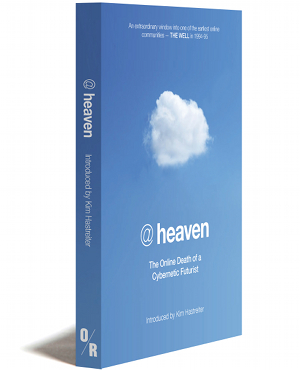
@heaven: THE ONLINE DEATH OF A CYBERNETIC FUTURIST

1994, northern California. The Internet is just emerging from military and university research labs. Groups of idealistic technologists, recognizing its potential as a tool for liberation and solidarity, are working feverishly to build the network.

In an early chat room, The WELL, a Stanford futurist named Tom Mandel creates a new conference asking for advice shaking off a persistent hacking cough. Within six months he is dead.

@heaven opens a window onto the way the Internet functioned in its earliest days. This electronic chronicle of a death foretold reminds us of the values of kinship and community that the Internet’s early pioneers tried to instill in a system that went on to take over the world.


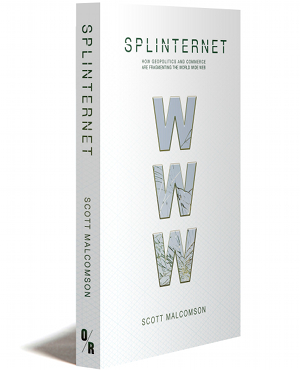
SPLINTERNET by Scott Malcomson

There’s always been something universalizing about the Internet. The World Wide Web has seemed both inherently singular and global, a sort of ethereal United Nations. But today, as Scott Malcomson contends in this concise, brilliant investigation, the Internet is cracking apart into discrete groups no longer willing, or able, to connect. The implications of this shift are momentous.

“This is not your ordinary history of the Internet. Scott Malcomson has brilliantly extended the connections between Silicon Valley and the military back far beyond DARPA—back, in fact, to World War I. If you want to understand the conflict between cyberspace utopians and the states and corporations who seek to dominate our virtual lives, you’ve got to read this book.” —James Ledbetter, editor, Inc. Magazine


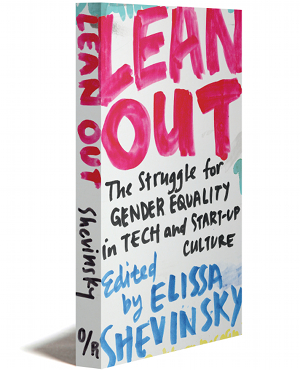
LEAN OUT edited by Elissa Shevinsky

Lean Out collects 25 stories from the modern tech industry, from people who fought GamerGate and from women and transgender artists who have made their own games, from women who have started their own companies and who have worked for some of the most successful corporations in America, from LGBTQ women, from women of color, from transgender people and people who do not ascribe to a gender. All are fed up with the glacial pace of cultural change in America’s tech industry.

“Disconcertingly thought-provoking.” —TechCrunch


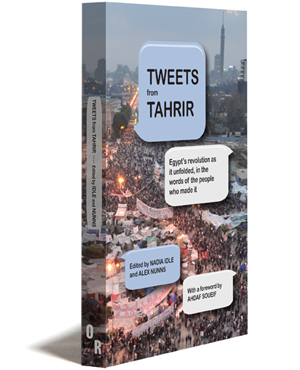
TWEETS FROM TAHRIR edited by Nadia Idle and Alex Nunns

The Twitter accounts of the activists who brought heady days of revolution to Egypt in January and February this year paint an exhilarating picture of an uprising in real-time. Thousands of young people documented on cell phones every stage of their revolution, as it happened. This book brings together a selection of key tweets in a compelling, fast-paced narrative, allowing the story of the uprising to be told directly by the people in Cairo’s Tahrir Square.

“Deeply moving, a record of great courage, mostly by young people, facing Mubarak’s legion of goons and regime thugs.” —Robert Fisk, The Independent


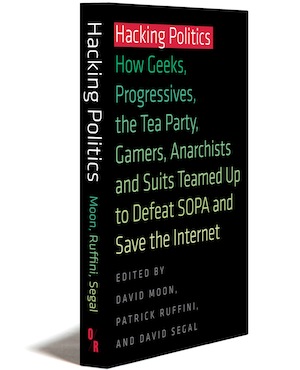
HACKING POLITICS edited by David Moon, Patrick Ruffini and David Segal

Hacking Politics is a firsthand account of how a ragtag band of activists and technologists overcame a $90 million lobbying machine to defeat the most serious threat to Internet freedom in memory. The book is a revealing look at how Washington works today – and how citizens successfully fought back.

Written by the core Internet figures—video gamers, Tea Partiers, tech titans, lefty activists and ordinary Americans among them—who defeated a pair of special interest bills called SOPA (“Stop Online Piracy Act”) and PIPA (“Protect IP Act”), Hacking Politics provides the first detailed account of the glorious, grand chaos that led to the demise of that legislation and helped foster an Internet-based network of amateur activists.


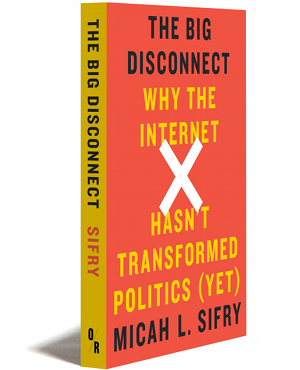
THE BIG DISCONNECT by Micah L. Sifry

Now that communication can be as quick as thought, why hasn’t our ability to organize politically—to establish gains and beyond that, to maintain them—kept pace? The web has given us both capacity and speed: but progressive change seems to be something perpetually in the air, rarely manifesting, even more rarely staying with us.

“No one better grasps the interplay between innovative media technology and politics than Micah Sifry.” —Kevin Phillips


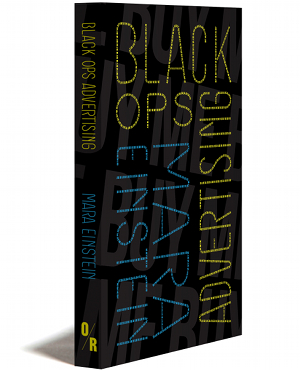
BLACK OPS ADVERTISING by Mara Einstein

From Facebook to Talking Points Memo to the New York Times, often what looks like fact-based journalism is not. It’s advertising. Not only are ads indistinguishable from reporting, the Internet we rely on for news, opinions and even impartial sales content is now the ultimate corporate tool. Reader beware: content without a corporate sponsor lurking behind it is rare indeed.

“Reading Mara Einstein is like putting on magic glasses that let you see the advertising all around you, all the time. Whether you’re looking to sell, or hoping to resist, here is the state of the art.” —Douglas Rushkoff, author, Throwing Rocks at the Google Bus, Present Shock

———————————————

Further Reading


what's yours is mine cover


beyond zero and one cover


“Charting the rise and rise of ‘sponsored content'” MARA EINSTEIN on ZDNet

Tuesday, August 9th, 2016

“In Black Ops Advertising, Mara Einstein… suggests a future in which
advertising increasingly subsumes all content. Everything will look
free, but hidden agendas, data collection and fakery will be everywhere.
This is the internet as con trick, where the natural human instinct to
share news and gossip is co-opted as low-cost marketing for brands and
others who do not fundamentally care about us except as sources of
revenue.”

To read more, visit ZDNet

Verified by MonsterInsights